
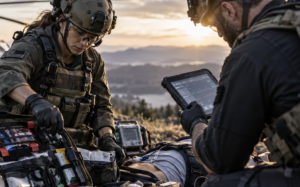
Emergency medicine has always depended on speed, preparation, and the ability to make sound decisions under pressure. What is changing is the amount of technology available to support those decisions. Information technology is moving beyond hospitals, offices, and command centers and becoming part of the equipment carried directly into emergencies.
Modern emergency response increasingly combines medical supplies with communications systems, digital sensors, mobile software, location technology, cloud platforms, and real-time data. These capabilities are changing how responders communicate, how patients are assessed, and how information moves from an incident scene to hospitals and command personnel.
The shift is especially significant for Tactical Trauma Kits, which are used in environments where responders may have only minutes to control severe injuries and stabilize a patient. As IT becomes faster, smaller, more reliable, and easier to deploy, emergency medical equipment is beginning to function as part of a larger connected response system rather than as isolated gear.
Emergency Response Is Becoming a Connected Environment
Emergency response once relied heavily on voice communications, paper documentation, and equipment that operated independently. Those methods remain important, but digital systems are creating a more connected operational environment.
The National Institute of Standards and Technology has devoted extensive research to public-safety communications, including broadband systems, location-based services, mission-critical communications, and technologies designed specifically for first responders. These developments illustrate how deeply information technology is becoming integrated into emergency services.
A responder treating an injured person may now operate within a network that includes dispatchers, medical personnel, incident commanders, hospitals, mapping systems, and other emergency units. Information can potentially move among those groups almost immediately.
This changes the role of field medical equipment. A trauma kit still needs dependable physical supplies, but the surrounding response process can increasingly include digital communication and information-sharing capabilities that help responders coordinate treatment and evacuation.
The result is an emergency response model in which medicine and IT work alongside one another.
Mobile Technology Is Bringing Information Directly to the Scene
Smartphones, rugged tablets, wearable electronics, and specialized mobile devices have become important components of modern field operations. Rather than relying entirely on information communicated verbally through a radio, responders can have access to visual and digital information while working.
Mobile systems can provide maps, patient information, treatment references, incident updates, weather conditions, evacuation routes, and communication with other responders.
This is particularly useful during incidents involving multiple casualties or several responding agencies. Information can become difficult to manage when numerous patients, vehicles, medical teams, and command personnel are operating simultaneously.
Digital tools provide a way to organize that information.
The broader concept of information technology includes computer systems, communications infrastructure, software, and data-processing technologies. Those same technologies are increasingly being adapted for public safety and emergency medicine.
A major advantage is portability. Computing power that once required large systems can now fit inside equipment carried by an individual responder.
As devices continue to become lighter and more durable, technology can accompany emergency personnel into environments where traditional computer systems would never have been practical.
Wearable Sensors Could Expand Field Patient Monitoring
Wearable technology represents one of the most interesting areas of development for emergency response.
Researchers have studied wearable sensors capable of monitoring first responders and service members in the field. The National Center for Biotechnology Information has published research discussing commercially available wearable sensors for continuous monitoring of service members and first responders.
Wearable systems can collect physiological information without requiring someone to remain connected to a conventional hospital monitor.
The possibilities for emergency medicine are substantial.
Future field systems could help monitor heart rate, oxygen saturation, temperature, movement, respiration, or other physiological measurements while medical personnel continue treating multiple patients. Information could potentially be displayed locally or transmitted to another member of the medical team.
The real value is not simply collecting more data. The value comes from delivering useful information to the right person quickly enough for that information to affect care.
IT developers therefore have an important challenge. Emergency technology must present data clearly and avoid overwhelming responders who are already operating under extreme pressure.
Real-Time Communication Can Reduce Information Delays
Communication remains one of the most important elements of emergency response.
A medical team may need to coordinate with law enforcement, fire departments, emergency medical services, dispatch centers, hospitals, and incident commanders. Every delay increases the possibility that important information will arrive too late.
Modern broadband networks are expanding what can be transmitted.
Voice communications remain essential, but newer systems can support data, maps, photographs, video, location information, and other digital resources. NIST has also been researching technologies such as 5G sidelink communications, which can allow compatible devices to communicate more directly in situations where conventional infrastructure becomes unavailable or unreliable.
That type of technology could become particularly valuable during natural disasters, remote operations, large emergencies, or incidents where cellular infrastructure has been damaged.
Reliable device-to-device communication could allow medical personnel to exchange critical information even when normal network coverage is compromised.
The long-term direction is clear. Emergency communications are moving beyond simple voice transmission toward interconnected digital environments capable of carrying many different types of operational information.
Location Technology Is Becoming Part of Emergency Medicine
Knowing where an emergency is occurring is only part of the challenge. Responders also need to know where patients, medical teams, vehicles, supplies, and evacuation points are located.
GPS technology has made outdoor positioning routine, but indoor locations can be much more complicated. Large buildings, underground structures, warehouses, stadiums, and multistory facilities can make traditional location systems less effective.
Public-safety researchers are consequently working on more advanced positioning and mapping systems.
Digital location systems could eventually help command personnel see where medical resources are positioned during a large incident. They could also help responders locate casualties, treatment areas, or evacuation routes.
When combined with mapping software, communication networks, and mobile devices, location data creates a more complete picture of an emergency.
That information can influence where resources are sent and how quickly injured people reach appropriate medical care.
Interoperability Will Determine How Useful Connected Medical Technology Becomes
Adding technology to emergency equipment provides limited value when the devices cannot communicate with one another.
Interoperability therefore represents one of the most important challenges facing connected medical technology.
The U.S. Food and Drug Administration describes medical-device interoperability as the ability of devices, technologies, products, or systems to safely and effectively exchange and use information.
For emergency response, interoperability could involve several layers.
A wearable sensor may need to communicate with a responder’s device. That device may need to communicate with an ambulance system. The ambulance may need to transmit information to a hospital. The hospital system then needs to interpret and display that data correctly.
If each component uses incompatible formats or communication methods, valuable information can become trapped inside individual systems.
The technology industry is therefore playing an increasingly important role in emergency medicine through the development of common standards, secure interfaces, and systems capable of sharing information across different platforms.
Cybersecurity Becomes Critical as Medical Equipment Gets Smarter
Connecting emergency medical systems to digital networks introduces an important responsibility.
Every connected device creates another potential cybersecurity consideration.
The FDA’s medical-device cybersecurity guidance emphasizes that connected medical devices can provide important benefits while also creating cybersecurity risks.
This matters because emergency medical technology operates in environments where reliability can have direct consequences for patient care.
Developers cannot treat cybersecurity as an optional feature added after a product has been created. Security needs to be incorporated into hardware, software, communications protocols, user authentication, data storage, and software-update procedures.
Emergency equipment creates additional challenges because devices may be deployed for long periods, transported between locations, used by multiple personnel, and connected through different networks.
A useful system must therefore balance accessibility with security. Responders need rapid access to essential functions without unnecessarily complicated procedures, while the system still needs protection against unauthorized access or manipulation.
IT professionals specializing in healthcare cybersecurity will become increasingly important as emergency medical equipment becomes more connected.
Cloud Platforms Could Improve Incident Coordination
Cloud computing has transformed business technology, and similar concepts can support emergency operations.
Instead of keeping information exclusively on individual devices, properly designed systems can synchronize information across multiple authorized users.
During a major incident, a centralized platform could help different teams maintain a common operating picture.
Patient counts, injury classifications, available resources, ambulance locations, hospital capacity, and other operational information could potentially be updated as an event unfolds.
This is particularly valuable during mass-casualty incidents because conditions can change rapidly.
A hospital that had available capacity earlier in an incident may eventually become overwhelmed. Another facility may become a better destination. Transportation resources may change. Additional medical supplies may arrive.
Digital systems can make those changes visible faster than traditional information-sharing methods.
The technical challenge is ensuring that these systems remain resilient. Emergency technology must continue operating when networks are congested, electricity is unavailable, or infrastructure is damaged.
Offline capabilities, local data storage, network redundancy, and synchronization technology will therefore remain important parts of system design.
Artificial Intelligence Could Help Organize Emergency Data
Artificial intelligence is also beginning to influence healthcare and public-safety technology.
In emergency environments, one potential role for AI is helping people process large quantities of information.
Sensors, communications devices, cameras, mapping systems, and medical equipment can generate enormous amounts of data. Human responders cannot realistically examine every piece of information simultaneously.
Software may eventually help prioritize that information.
An intelligent system could identify changes in patient measurements, organize incoming reports, recognize unusual patterns, or help direct attention toward information requiring immediate review.
The most effective systems will likely function as decision-support tools rather than replacements for trained medical professionals.
That distinction is important.
Emergency medicine involves unpredictable environments, incomplete information, human behavior, and situations that cannot always be reduced to an algorithm. Technology can help organize information, but qualified personnel remain responsible for interpreting conditions and making treatment decisions.
Augmented Reality May Change How Responders Receive Instructions
Augmented reality represents another developing technology with potential applications in emergency response.
Instead of repeatedly looking down at a handheld screen, a responder could receive selected information through a wearable display. Navigation instructions, patient information, evacuation directions, or equipment guidance could potentially appear within the user’s field of view.
This could allow responders to access digital information while keeping their hands available for medical work.
The challenge will be designing interfaces that provide useful information without distracting the person wearing the device.
Emergency environments already contain significant visual and auditory stimulation. Poorly designed technology could increase cognitive load rather than reduce it.
Developers will therefore need to focus heavily on usability.
NIST research involving thousands of first responders has emphasized the importance of understanding how technology actually performs within the environments where emergency personnel work. Its Voices of First Responders research gathered input from police, fire, emergency medical, and 911 personnel about communications technology and future improvements.
Successful emergency technology has to work for the responder, rather than forcing the responder to work around the technology.
Data Could Improve Emergency Preparedness Before an Incident Happens
One of IT’s greatest contributions may occur before an emergency begins.
Data collected from previous incidents can help agencies understand response times, supply usage, communication failures, geographic patterns, and operational bottlenecks.
Organizations can use that information when planning equipment placement and response procedures.
A department may discover that certain supplies are used more frequently than expected. Another may identify areas where communication coverage is unreliable. Large facilities may use digital mapping to prepare evacuation and treatment locations before an incident occurs.
Inventory technology can also improve readiness.
Barcode systems, RFID technology, connected inventory platforms, and automated expiration tracking can help organizations maintain medical supplies more efficiently. Equipment can be checked, replaced, and distributed using digital records rather than relying entirely on manual inspection.
That may sound less dramatic than artificial intelligence or wearable sensors, but logistics has enormous importance during emergencies.
Advanced technology provides little benefit if essential medical supplies are missing, damaged, or expired when they are needed.
The Future Will Combine Physical Equipment With Digital Infrastructure
The next generation of emergency medical equipment will probably not be defined by a single breakthrough device.
The larger change will come from integration.
Physical supplies will continue to perform the immediate medical functions responders depend on, while digital technology increasingly surrounds those supplies with communication, monitoring, navigation, documentation, and information-sharing capabilities.
A field responder could eventually operate within an ecosystem that includes wearable sensors, secure mobile communications, real-time patient records, indoor positioning, automated inventory systems, intelligent decision support, and direct communication with receiving hospitals.
Each technology already exists in some form. The major technological challenge is connecting them in ways that remain reliable, simple, secure, and practical under emergency conditions.
That places IT companies, software developers, cybersecurity specialists, network engineers, medical-device manufacturers, and emergency-response agencies at the center of the next stage of innovation.
Conclusion
Information technology is reshaping emergency response because modern emergencies depend on more than medical supplies alone. Responders also depend on communication, location information, reliable data, coordination, security, and rapid access to knowledge.
Mobile computing, wearable sensors, broadband communications, cloud platforms, artificial intelligence, cybersecurity, interoperability, and location technology are steadily becoming part of the same emergency-response ecosystem.
The most meaningful advances will be the ones that make emergency care simpler rather than more complicated. Technology should reduce delays, improve coordination, provide relevant information, and help trained professionals concentrate on the injured people in front of them.
As computing continues moving out of traditional offices and into the field, IT will play an increasingly important role in determining how emergency medical equipment is designed and how quickly responders can act. The future of trauma response is becoming connected, data-driven, and mobile, bringing technology closer to the precise moments when every second matters.