
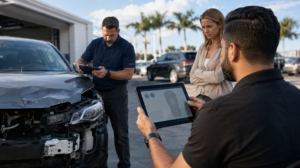
A serious collision can leave a driver facing two separate problems. The first is the damaged vehicle sitting at a repair facility or storage yard. The second is determining what that vehicle was actually worth immediately before the crash. That second problem has become increasingly dependent on information technology.
Insurance companies once relied heavily on printed valuation books, telephone calls to dealerships, handwritten repair estimates, and the personal judgment of local adjusters. Today, much of the process runs through databases, estimating platforms, vehicle-history systems, digital photographs, market-comparison software, and automated decision tools. A claim involving Total Loss Florida may now be influenced by thousands of pieces of information gathered and processed in a matter of minutes.
This technology can make claims faster and provide access to more market data. It can also produce serious valuation problems when the information entered into the system is incomplete, outdated, or based on vehicles that are not truly comparable. Florida drivers therefore need to understand both the convenience and the limitations of the technology being used to calculate the value of a wrecked vehicle.
From Printed Guides to Digital Valuation Platforms 💻
Before digital claim systems became standard, determining a vehicle’s value required considerably more manual work. An adjuster might review a printed pricing guide, call nearby dealerships, inspect newspaper advertisements, and compare recent sales. That approach could be slow, but the person handling the claim often had a direct view of the local market.
Modern valuation software can search large inventories of vehicles almost instantly. A system may consider the damaged vehicle’s model year, make, trim level, engine, mileage, equipment, general condition, location, and recent asking prices for similar vehicles. The information is then organized into a report that helps the insurer calculate an actual cash value.
The general insurance concept of a total loss occurs when repairing damaged property is no longer economically practical compared with its insured or market value. In an automobile claim, however, the final calculation is rarely as simple as comparing one repair estimate with one advertised price. Salvage value, projected repair supplements, rental expenses, labor costs, parts availability, taxes, fees, and policy terms can all affect the insurer’s decision.
Technology allows those factors to be analyzed quickly. Speed, however, does not automatically guarantee accuracy.
The Vehicle Identification Number Starts the Digital Trail 🔍
The vehicle identification number acts as the foundation of the modern valuation process. It allows computer systems to identify many of the vehicle’s original specifications and distinguish one configuration from another.
The public NHTSA VIN Decoder can identify information encoded in a VIN, including details associated with the manufacturer, vehicle type, model, and production specifications. Insurers and valuation vendors may combine VIN information with additional commercial databases to build a more complete digital profile.
This matters because vehicles that appear similar may have very different market values. A base model should not automatically be treated as comparable to a premium trim with advanced safety technology, upgraded seating, a larger engine, towing equipment, or an expensive entertainment package. Even two vehicles with the same model name can differ by thousands of dollars.
A single decoding error can affect the entire report. Missing factory options, an incorrect trim package, or the wrong drivetrain may cause the software to select lower-priced comparison vehicles. Drivers should review the valuation report carefully and confirm that the VIN, mileage, trim, equipment, and overall configuration are correct.
Digital Repair Estimates Can Push a Vehicle Toward Total-Loss Status 🛠️
Valuation technology represents only one side of the calculation. Repair-estimating software also plays a major role.
After an accident, an appraiser or repair facility may upload photographs, scan diagnostic codes, document visible damage, and enter the affected parts into an estimating platform. The software calculates estimated labor hours, paint materials, parts prices, procedures, taxes, and other repair-related expenses.
Newer vehicles make this process more complicated. A damaged bumper may contain cameras, radar sensors, parking sensors, wiring, and mounting brackets. Replacing the visible panel might also require electronic calibration. Headlights, windshields, mirrors, seats, steering components, and body panels can contain technology that substantially increases the repair cost.
Initial estimates may also change after the vehicle is disassembled. Hidden structural damage, damaged wiring, unavailable parts, additional calibration procedures, and manufacturer-required operations can increase the total. Digital estimating systems make it easier to issue supplements, but those supplements can move a borderline vehicle closer to being declared uneconomical to repair.
Florida’s Department of Financial Services explains that when repair costs meet or exceed 80 percent of a vehicle’s value, an insurer may offer payment to replace it with one of like kind and quality. The vehicle is then reported to the Florida Department of Highway Safety and Motor Vehicles.
Florida Law Still Controls the Settlement Process ⚖️
Software may perform the calculation, but the computer does not replace Florida law.
Under Florida Statute 626.9743, an insurer settling certain first-party motor vehicle losses on an actual-cash-value basis must use one of the methods permitted by the statute. One option is a cash settlement based on the actual cost of purchasing a comparable motor vehicle, including applicable sales tax.
That requirement gives real importance to the vehicles selected by the valuation software. A comparison vehicle should reasonably match the loss vehicle in areas such as model, equipment, mileage, condition, and market location. A report filled with lower trims, distant listings, unusually high-mileage vehicles, or cars with different equipment may not reflect the cost of obtaining a genuine replacement.
Florida’s title law also establishes rules for damaged vehicles. Florida Statute 319.30 defines circumstances under which a motor vehicle is treated as a total loss and addresses salvage certificates of title and certificates of destruction. The statute includes the 80 percent repair-cost standard for certain uninsured vehicles while also addressing insurer-paid replacement losses.
The FLHSMV total-loss settlement procedure provides additional administrative guidance for insurance-company settlements and title processing. These official requirements remain important even when nearly every step of the claim is handled electronically.
Market Comparables Can Strengthen or Distort the Result 📊
Digital market searches are among the most useful improvements in vehicle valuation. A computer can review far more listings than one adjuster could reasonably locate by hand. The quality of the result, however, depends on the quality of the comparisons.
An advertised vehicle may be located hundreds of miles away, have substantially higher mileage, contain fewer options, or be in poorer condition. Some listings may already be sold, duplicated across multiple websites, incorrectly described, or priced unusually low to attract attention. A vehicle advertised at a low price may also include dealer conditions that are not obvious in the listing.
The opposite problem can occur as well. An unusually expensive listing does not prove that every similar vehicle has the same value. Asking prices and completed sales are different forms of evidence. A reliable valuation should reflect a reasonable pattern within the relevant market rather than depend heavily on one unusually cheap or unusually expensive vehicle.
Location also matters. Florida is not a single, perfectly uniform automobile market. Inventory, demand, weather exposure, dealership pricing, transportation costs, and local vehicle preferences may differ between Miami, Orlando, Tampa, Jacksonville, Tallahassee, and smaller communities. Technology can expand the search area, but expanding it too far may produce comparisons that do not reflect what the owner would actually pay nearby.
Artificial Intelligence Is Entering the Claims Department 🤖
Artificial intelligence is beginning to influence several parts of insurance claims. Image-recognition tools can identify visible vehicle damage. Predictive systems can estimate whether a claim is likely to require supplements. Automated workflows can organize documents, flag inconsistencies, detect possible fraud, route claims, and recommend whether a vehicle should be inspected in person.
These systems can reduce routine administrative work, but an algorithm is only as dependable as its data, design, and oversight. A model trained on incomplete claims, inaccurate listings, or historical assumptions may repeat those problems on a larger scale.
The National Institute of Standards and Technology AI Risk Management Framework emphasizes the importance of managing risks connected with artificial intelligence and developing systems that are valid, reliable, transparent, explainable, privacy-enhanced, and fair. Those principles are especially relevant when automated systems influence financial decisions affecting consumers.
The Federal Trade Commission’s work involving artificial intelligence also highlights consumer-protection concerns surrounding automated technologies. Insurance valuation systems are specialized tools rather than consumer chatbots, but the broader lesson remains the same. A company should be able to support the claims made about its technology and should not treat automation as an excuse for unfair or deceptive results.
More Data Does Not Always Mean a Fairer Settlement 📱
A modern valuation platform can process vehicle listings, mileage records, equipment codes, geographic information, photographs, repair estimates, and historical claim data. That amount of information can make a report appear precise and authoritative.
Precision and fairness are not identical.
A valuation of $24,186 may look more scientific than a rounded estimate of $24,000, but the extra digits do not prove that the underlying comparisons were appropriate. The result can still be inaccurate when the system begins with the wrong trim, excludes valuable options, applies unsupported condition deductions, or relies on unsuitable vehicles.
Condition adjustments deserve particular attention. A valuation company may adjust a comparison vehicle upward or downward to account for differences between that listing and the damaged vehicle. Some adjustments are reasonable. Others may be difficult for a consumer to verify without photographs, inspection notes, maintenance records, and a clear explanation of the methodology.
The National Association of Insurance Commissioners’ auto insurance resources encourage consumers to understand their coverage and the way automobile insurance claims operate. A valuation report should be treated as supporting evidence, not as an unquestionable verdict produced by a computer.
Drivers Can Use Technology to Review the Technology 📲
The same digital tools available to insurers can help vehicle owners evaluate a settlement.
A driver can search local dealership inventory, save comparable listings, decode the VIN, obtain factory equipment information, organize maintenance receipts, document recent upgrades, and compare the insurer’s selected vehicles with genuinely similar alternatives. Screenshots should include the listing date, price, mileage, location, trim, options, and dealer information because online advertisements can disappear quickly.
Owners should also review every page of the insurer’s report. The most important details often appear deep within the document rather than on the settlement summary. Mileage adjustments, condition ratings, option deductions, geographic expansion, projected sold-price adjustments, and fees can all change the final figure.
Florida’s automobile insurance consumer information provides guidance on total-loss claims and other common coverage issues. Consumers experiencing difficulty with an insurer can also use the state’s insurance assistance resources rather than relying solely on information supplied by the company handling the claim.
Independent Appraisals Remain Important in a Digital Market 🚗
Technology has not eliminated the need for professional judgment. In many disputed claims, it has made that judgment even more important.
An independent vehicle appraiser can examine whether the loss vehicle was correctly identified, whether its options were included, whether condition deductions were justified, and whether the comparison vehicles reflect the relevant Florida market. An appraiser may also identify local inventory that automated software overlooked or explain why certain listings should not have been used.
The strongest appraisal is not simply a higher number. It is a documented opinion supported by accurate vehicle information, credible market evidence, photographs, adjustments, and a clear explanation. That type of analysis gives the vehicle owner a practical basis for challenging errors rather than relying on frustration or emotional attachment to the car.
Digital systems are useful, but they still require accurate inputs and responsible human review. An experienced professional can recognize when a report technically completed its calculation while failing to capture the true characteristics of the vehicle.
Conclusion
Information technology has transformed the way wrecked vehicles are inspected, estimated, compared, and valued in Florida. VIN databases identify vehicle specifications. Digital estimating platforms calculate repair costs. Market-search systems locate comparable inventory. Artificial intelligence reviews photographs, organizes claims, and predicts outcomes.
These tools can shorten claim times and make more information available. They can also hide significant mistakes behind polished reports and precise-looking numbers. Incorrect trim data, missing equipment, weak comparison vehicles, unsupported deductions, and overly broad geographic searches can all reduce a settlement.
The most reliable process combines technology with transparency, accurate evidence, Florida law, and informed human review. Drivers who understand how the systems work are better prepared to examine a valuation report, identify errors, gather stronger market evidence, and determine whether the proposed payment reflects the real cost of replacing their vehicle.