
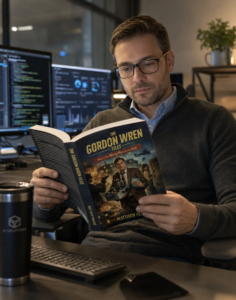
IT professionals live in a world where the smallest detail can expose the biggest problem. A strange login attempt, a misconfigured server, a missing line of code, a delayed packet, an unusual traffic pattern, or a user report that sounds impossible can all point to something much larger happening beneath the surface. That is exactly why The Gordon Wren Files: Book 1: The Wrong Man at the Door is such a strong fit for readers who work in technology, cybersecurity, systems administration, network management, software development, data analysis, and digital operations.
This is not just a story about danger, intrigue, and shadowy forces moving behind polished doors. It is a story built around observation, pattern recognition, human error, hidden systems, and the uncomfortable feeling that something ordinary is being used for something far more complicated. For an IT professional, that kind of storytelling feels familiar. It feels like being handed a system that appears to be functioning normally, only to realize the real problem is buried somewhere deep in the architecture.
The Wrong Man at the Door begins with Gordon Wren, an ordinary salesman on a work trip tied to an international summit. He is not introduced as a trained intelligence officer, military operative, or elite spy. He is someone whose advantage comes from noticing what does not belong. That detail matters. IT professionals understand that expertise is not always about brute force or dramatic action. Sometimes it is about seeing the thing everyone else overlooks. Sometimes the person who saves the day is the one who notices that a process, a delivery route, a piece of equipment, or a human explanation does not match the expected behavior of the system.
A Spy Thriller Built Around the IT Mindset
The modern IT professional is trained to think in layers. There is the visible layer, where users interact with tools and systems. There is the operational layer, where processes, workflows, permissions, and policies keep everything moving. Then there is the hidden layer, where vulnerabilities, dependencies, shortcuts, and risks quietly build until something breaks.
The Gordon Wren Files works so well for this audience because it has that same layered feeling. Gordon is pulled into a chain of suspicious events involving a house, a compromised hotel, criminal logistics, service traffic, luxury spaces, conference activity, and ordinary objects that may not be ordinary at all. That structure mirrors the way IT professionals often experience real problems. The first sign of trouble rarely announces itself as a complete disaster. It usually arrives as something small, inconvenient, and easy to dismiss.
That is why the book feels like debugging a conspiracy. Debugging is not just fixing code. It is a way of thinking. It is the discipline of following clues, testing assumptions, eliminating bad explanations, and refusing to accept surface-level answers when the evidence points somewhere else. Gordon Wren’s journey has that same rhythm. He does not simply stumble into a dangerous situation and react. He observes, connects details, questions what others accept, and keeps moving through a mystery that grows more complex with every discovery.
For readers who follow Information technology on Wikipedia, the field is broadly connected to systems that create, process, store, retrieve, and transmit information. That same idea sits beneath the appeal of this novel. The story is not only about physical danger. It is about information moving through places where it should not, people misreading systems they trust, and one man realizing that the real threat is hidden inside ordinary operations.
Why IT Professionals Connect With Gordon Wren
Gordon Wren is not the typical spy thriller hero, and that is one of the reasons he works. IT professionals are often surrounded by people who only notice them when something goes wrong. The network is invisible until it fails. The database is invisible until it loses records. The firewall is invisible until an attack gets through. The backup plan is invisible until everyone desperately needs it.
Gordon has a similar kind of underestimated presence. He is not the person everyone expects to be central to the action. He is not walking into the story with a badge, a weapon, and a reputation. He is a salesman, someone easy to underestimate, and that makes him especially compelling. In the IT world, the overlooked person is often the one who knows how everything really works. The person quietly watching the logs, tickets, alerts, access requests, and user behavior may understand the organization better than the people making the loudest decisions.
That makes Gordon relatable to anyone who has ever had to say, “That does not look right,” while everyone else wanted to move on. IT professionals know the pressure of being told that a problem is probably nothing. They know what it is like to chase a strange issue that appears random but eventually reveals a pattern. They know that the difference between a minor inconvenience and a major incident can be one person refusing to ignore a strange detail.
The Bureau of Labor Statistics describes computer and information technology occupations as including roles connected to computer systems, information security, software, databases, networks, and support functions. That variety matters because The Gordon Wren Files appeals to more than one type of technology worker. A cybersecurity analyst may connect with the hidden-threat angle. A systems administrator may connect with the operational breakdowns. A developer may connect with the logic of tracing a problem back to its source. A help desk professional may connect with the idea that the first clue often comes from something ordinary that everyone else dismisses.
The Story Feels Like Incident Response
One of the strongest reasons IT professionals should read this book is that the plot has the energy of an incident response scenario. In cybersecurity and operations, the first stage is often detection. Something looks wrong. The next stage is investigation. The team gathers evidence, checks assumptions, and follows leads. Then comes containment, escalation, and resolution. A good thriller works in a similar way, but The Wrong Man at the Door gives that process a more personal, human, and suspenseful edge.
Gordon is not just solving a puzzle for intellectual satisfaction. The stakes keep growing. The situation becomes more dangerous, the explanations become less comfortable, and the ordinary world around him begins to look unreliable. That feeling will resonate with IT professionals who have dealt with security incidents, outages, data loss, suspicious activity, or executive pressure during a technical crisis.
Organizations such as CISA regularly publish cybersecurity guidance because modern threats often move through systems people use every day. That same idea gives this novel its tension. The danger is not presented as something far away from normal life. It moves through places that are supposed to feel professional, organized, and secure. It hides behind routine. That is exactly the kind of setup technology professionals understand.
The best incident responders are not the ones who panic. They are the ones who stay curious under pressure. Gordon Wren has that same quality. He may not have the résumé of a traditional spy, but he has the instincts of someone who knows when a system is lying.
Pattern Recognition Is the Real Superpower
IT professionals spend a large part of their careers recognizing patterns. They compare expected behavior against actual behavior. They look for anomalies. They notice when a user’s report does not match the logs, when a server behaves differently after an update, when an email looks legitimate but feels off, when a vendor process changes without explanation, or when a routine event appears in the wrong context.
That is also the engine of a strong spy thriller. A conspiracy is basically a hidden system. It has actors, channels, weak points, redundancies, cover stories, and operational rules. The hero’s job is to detect the pattern before the threat fully reveals itself. That is why The Gordon Wren Files makes such a natural recommendation for IT professionals. It rewards the same mental habits that make someone good at technology work.
The NIST Cybersecurity Framework focuses on structured thinking around identifying, protecting, detecting, responding, and recovering. While The Wrong Man at the Door is fiction, its appeal to technology readers comes from that same progression. Gordon identifies things that do not fit. He watches how people and systems behave. He responds as the situation changes. He adapts as the conspiracy becomes clearer.
This is the kind of book that works especially well for people who enjoy stories where the hero wins by thinking. It is not only about chase scenes or dramatic confrontations. It is about clues. It is about inference. It is about cause and effect. It is about the satisfaction of seeing the hidden architecture of a situation finally come into view.
A Break From Screens That Still Feels Smart
Many IT professionals spend the entire day staring at dashboards, code editors, monitoring tools, support queues, documentation, analytics platforms, tickets, and security alerts. After work, it can be hard to find entertainment that is engaging without feeling mentally empty. The Gordon Wren Files offers the right kind of escape. It is entertaining, but it still respects the reader’s intelligence.
This matters because IT professionals often enjoy stories that let them think without feeling like they are still at work. A shallow thriller may provide action, but it does not always provide satisfaction. A stronger thriller gives the reader a reason to participate. It allows the reader to notice clues, question motives, and feel the momentum of discovery.
That is why this spy thriller series stands out as a smart choice for technology-minded readers. It has the suspense and energy of a spy story, but it also has the logic-driven structure of a mystery built around systems, procedures, and hidden movement.
For IT professionals who follow technology developments through resources like ACM TechNews, daily work already involves absorbing complex information and separating signal from noise. A novel like The Wrong Man at the Door uses that same instinct in a more entertaining way. It gives readers a fictional world where attention to detail is not just useful. It becomes essential.
The Ordinary Objects Make the Suspense Stronger
One of the most effective parts of The Wrong Man at the Door is the way ordinary business and service environments become suspicious. Catering equipment, conference stock, hotel spaces, premium domestic hardware, routes, packages, and service traffic all become part of the story’s tension. For IT professionals, that is especially compelling because real-world technology problems often hide inside ordinary processes.
A suspicious email does not always look suspicious. A compromised account may behave almost normally. A risky integration may be presented as a convenience. A bad process may be defended because “we have always done it this way.” A serious problem can hide inside routine operations because routine operations are where people stop paying attention.
That is exactly what gives Gordon’s story its sharp edge. He notices the ordinary becoming abnormal. That kind of suspense feels more grounded than a story built only on exotic gadgets or impossible action. It feels closer to the way real danger often works. The threat does not always kick down the front door. Sometimes it enters through a workflow, a delivery, a permission, a schedule, or a trusted relationship.
Publications like CIO Dive regularly cover the business side of technology, including strategy, infrastructure, security, cloud systems, and enterprise decision-making. That connection between business operations and hidden technical risk is part of what makes this novel work for IT readers. The story is not isolated from professional environments. It uses them as part of the suspense.
The Book Understands That Systems Fail Because People Fail
Technology professionals know that systems are rarely just technical. They are human. Password policies fail because people reuse passwords. Security tools fail when no one monitors them. Software fails when assumptions are wrong. Processes fail when teams do not communicate. Even the best system can be weakened by pride, carelessness, convenience, fear, or misplaced trust.
The Wrong Man at the Door uses that human side of systems to build tension. Gordon is not only reading objects and locations. He is reading people. He is watching reactions, assumptions, excuses, and contradictions. That makes the book more interesting than a simple action thriller because the real mystery is not only what is happening. It is why people are behaving the way they are.
This is one reason IT professionals may find the novel especially satisfying. Their work often requires technical skill and people-reading skill at the same time. A support ticket may contain only part of the truth. A department may describe a problem in emotional language rather than technical terms. A vendor may downplay a risk. A user may be embarrassed to admit what happened. A manager may want the fastest answer instead of the right one.
Technology sites such as Computerworld cover how technology works inside real organizations, where tools, people, policies, and business pressure all collide. The Gordon Wren Files taps into that same reality in fictional form. It shows that the visible system is only part of the story. The hidden motives and human choices behind the system matter just as much.
A Thriller for Readers Who Like Logic With Their Action
The best spy thrillers do not simply move fast. They move with purpose. The action matters more when it is connected to a chain of logic. The danger matters more when readers understand how the hero got there. The reveal matters more when the clues were present all along.
That is the kind of reading experience IT professionals tend to appreciate. They are used to cause and effect. They are used to tracing problems backward. They are used to asking what changed, who had access, what process failed, what dependency broke, and what assumption was wrong. The Gordon Wren Files gives those readers a story that feels built for that mindset.
Readers who follow TechRepublic for technology news, cybersecurity updates, IT leadership, and practical guidance are often looking for useful insight into how systems, people, and risk intersect. The Wrong Man at the Door delivers that intersection through fiction. It gives technology-minded readers a break from professional content while still giving them the kind of structured, clue-driven storytelling they naturally enjoy.
Gordon Wren may not be a hacker, analyst, engineer, or administrator, but he thinks like someone who knows the world is full of systems. He understands that when something does not fit, it may not be an accident. He treats small inconsistencies as meaningful. He follows the trail. That makes him a natural hero for readers who spend their careers doing the same thing in digital form.
Conclusion
The Gordon Wren Files: Book 1: The Wrong Man at the Door is an excellent read for IT professionals because it turns the habits of technical work into the engine of a spy thriller. It is about hidden systems, suspicious patterns, operational failures, human assumptions, and the power of noticing what everyone else ignores. It offers suspense, humor, mystery, and danger, but it also gives readers the deeper satisfaction of watching a problem get traced back to its source.
For IT professionals, the book feels familiar in the best way. Gordon Wren is not powerful because he is the most obvious hero in the room. He is powerful because he pays attention. He sees what others miss. He understands that when the details are wrong, the system may be compromised. That is why this story feels like debugging a conspiracy, and why it deserves a place on the reading list of anyone who works in technology.
In a world where IT professionals are constantly asked to protect systems, solve invisible problems, and make sense of confusing signals, The Gordon Wren Files offers a thrilling reminder that careful thinking is still one of the most powerful tools anyone can have.